
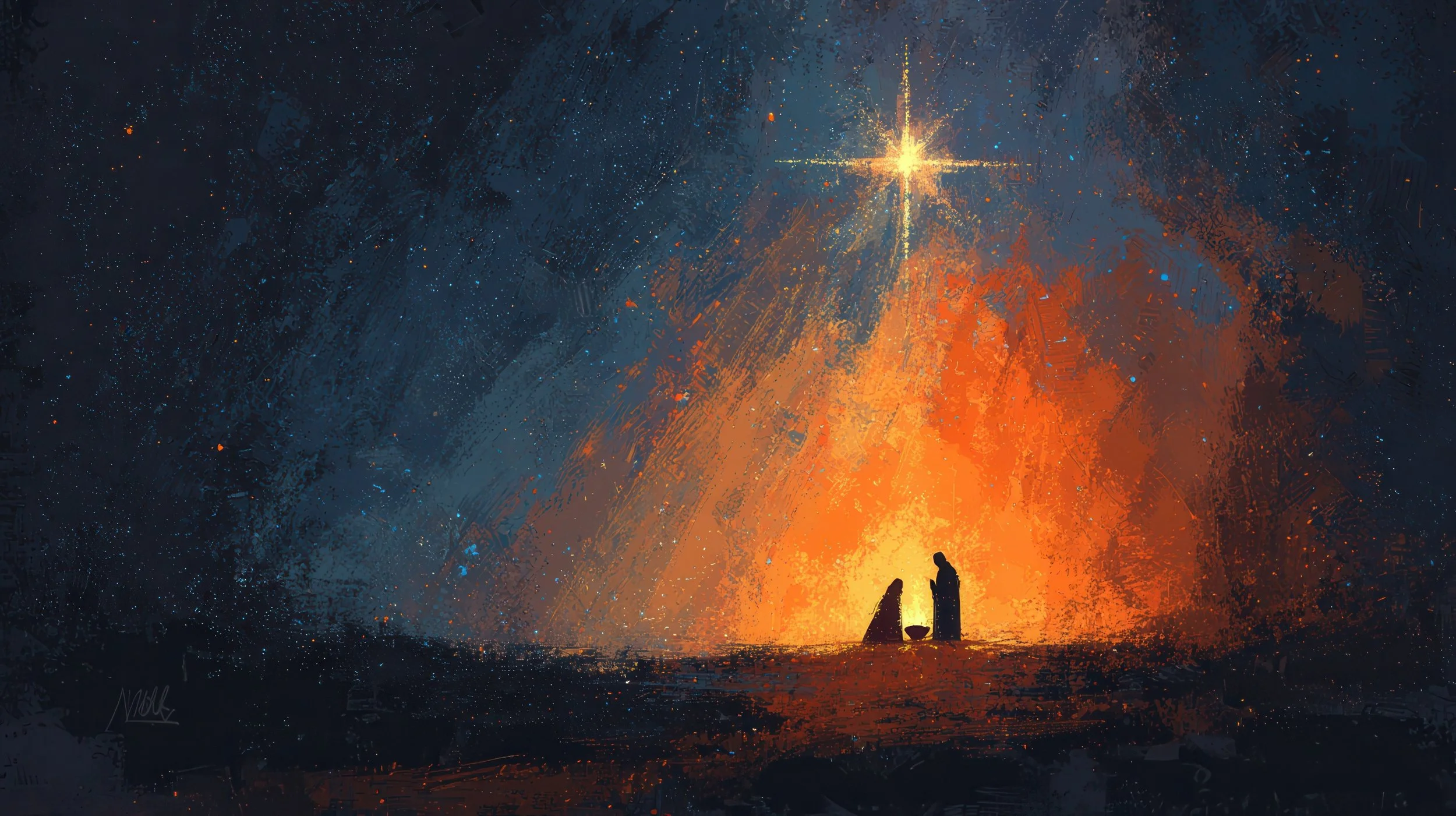
Light of God’s Love
“What came to be through him was life, and this life was the light of the human race.” – Jn 1:3-4
“I would risk everything to be with my family. They are my home.” These were the words of Pedro, a deported migrant I recently met at a shelter in Tijuana, Mexico. After 50 years in the U.S., his entire family remains on the other side of the border. Like many others, Pedro is still willing to risk detention or deportation again, just to be with those he loves.
In Pedro, I encountered the God we celebrate at Christmas: Jesus, who crossed every border—divine to human, heaven to earth—risking everything to be with us.
Last night, Pope Leo preached powerfully in his Christmas Eve Homily: “The divine light radiating from [the Child Jesus] helps us to recognize humanity in every new life … The Lord chooses to reveal himself in each human being, who reflects his true image … There is no room for God if there is no room for the human person. To refuse one is to refuse the other. Yet, where there is room for the human person, there is room for God.”
He spoke indirectly of migrants and directly of Christmas: “[God] does not give us a clever solution to every problem, but a love story that draws us in … Before violence and oppression, he kindles a gentle light that illumines with salvation to all the children of this world.” The mystery of Christmas reminds us that every ordinary moment—every anxiety, uncertainty, or struggle—is pregnant with divine love.
Today, we celebrate a love born in a manger and carried to the cross. In Pedro, I saw that love—a God willing to bear any cost to be with us who are the beloved. When we see someone who is poor, who forgives, who loves—we see God. God who is poor. God who forgives. God who loves.
God chooses to shine light most clearly through human beings, through you and me. Through us who are poor, weak, and sinful. This is the glory of God’s humility. This is the light of God’s love.
Where in your life is God crossing borders to be close to you? How might you make space for the “human person”—especially the migrant or stranger—and so make space for God?
Tri Dinh, SJ